
Average User Rating
Rating Breakdown
Write a User Review S. Shmueli
 IL
Visited:
July 2010
Reviewed: Mar 26, 2013
IL
Visited:
July 2010
Reviewed: Mar 26, 2013
Experience level: 2-5 safaris
Our trip to Namibia
The tour was organized for four people, my wife, me, and a couple of friends, in the tour guide's well equipped VW van.
It was planned to July and we were really lucky, as it was not too hot and it did not rain at all. During the days it was quite warm, but the evenings were a bit chilly, needing a sweater or a light coat.
Our tour driver/guide named Phillip, besides being an excellent driver, is a local born person, who grew up there. He knows every tree, animal, road or dune, almost personally. He also owns a small farm and speaks fluent English, German and Afrikaans.
In many aspects, Namibia
Read more
has a lot of unique things to offer, landscapes, tribes and an atmosphere, that can not be found elswhere, as I will describe later on. Namibia's population includes 6% white people, mostly of German origin, a small "baster" community of mixed "Afrikaaners" with women from "kikuyu Nama" tribe, and ten more native tribes who marry mostly within the tribe, while intermarriage is not common.After arriving Windhoek in the evening, Phillip took us straight to the nice "Safari" hotel, where we spent the night before leaving early in the next day.
That day was dedicated to showing and explaining Namibia generally, and the area around Hammerstein, the landscape, the fauna and flora, the ranch system, the water sources, and hardly any agriculture.
In the late afternoon, we arrived at the Hammerstein lodge, where we could also watch a few wild animals behind a fence, including a pair of tame cheetahs, who let us caress them, without grabbing a leg or an arm. This lodge, was a really nice place to stay in. We were served with real hearty dinner and breakfast, as in some other lodges and hotels.
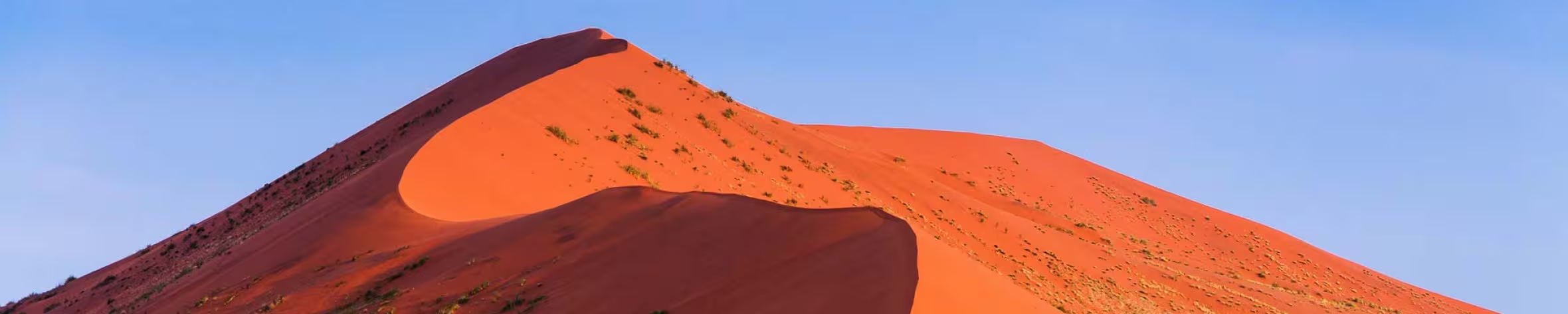
The next day, had to be a really long one, so we started very early. We went by the 'Tsauchab' that once was a river, lost in the dunes, then through the 'Sesriem' park, where we entered the 'Sossuvlie' reserve. This is a wide long valley, with huge sand dunes towering on both sides, a real breath taking view. Most dunes have a sharp twisting edge, therefore when the sun is low, the contrast between the lit area and the shaded area creates a very dramatic scenery. The sand color, changes between yellow to light orange, depending on the time of the day, and the content of iron oxide in it. The dunes estimated age, is about 5000 million years.
They are numbered from 1 to 49, and dune 45 is the only one allowed to climb on, which is a very hard task for normal people. Some of them have even names, and one of the greater ones is called: 'Big Daddy'. We drove to the western edge of the valley, to the 'Sossuvlei flat', and walked to the near 'Dead vlei', with its dramatic view of the dark dead tree trunks, on a flat, almost white sand surface. Then it was already time to start heading back. We took a short side trip, to look at the unique small and deep 'Sesriem' canyon, dug in the "Conglomerate" stone by a prehistoric river. From there we drove to the 'Namib Desert Lodge', situated near the 'petrified dunes' site.
These dunes are not moving by the wind. Millions of years ago, because of heavy rains and water lodging, the sand particles clamped together, and formed a kind of sandstone, colored brown red. More sand was drifted by the wind to cover them, therefore their tops are rounded.
The dune tops are a popular site to watch colorful sun sets. The lodge teem drives you to the top, and sets a table with refreshments, to make your time more enjoyable.
During the next days we met many animals, Oryxes, ostriches, springboks, zebras, jackals, and a bird named: Ruppill's Korhanes, found only in Namibia. We drove to 'Solitaire', an ex farm turned to a gas station, garage and an apple cake bakery. Then we continued north, along the 'Naukluft' reserve and entered a vast flat area, with many strange looking plants, named: 'Welvitchia Mirabilis'. The older one's age is estimated as 500 to 800 years and they exist as male and female plants. In the afternoon we arrived to 'Swakopmund' town, where most people are of German origin. We visited the local small museum, presenting stuffed local animals, old tools, local history, the tribes, and many artifacts.
Next morning we drove to 'Walvis Bay', a small township with a fishermen's port. There special boats take tourist for a sail in the neighborhood, to watch sea gals, pelicans, seal colonies, flamingoes and dolphins. We continued north to the 'Skeleton coast', to see the skeletons of grounded and abandoned ships, slowly rotting in the salty mist.
Then we continued to 'Hentieabaai', a small place making a living from local tourism that comes to stay a while, during December and January.
From there we turned north east on C35 road towards 'Uis' and 'Khorixas', a long drive through a flat wilderness. There we could see the highest mountain in Namibia, 'Mt. Brandberg', towering to 2573 meters, on our left. This region is 'Damaraland', where most of the 'Damara', considered as the poorest tribe, is living. 'Uis' used to be a small miners' town, until the zinc mine was closed. Vegetation is very scarce but one cactus like, huge plant named: 'Euphorbia Virosa', is growing there, in big numbers. It is a dangerously poisonous plant, that one should not ever touch its sap.
Many 'Herreru' tribe women moved to Damaraland because they realized that tourism is a source of income. They sew their clothes with hand operated sewing machines, and sell dolls and clothing to tourists driving by. They wear hats with hornlike edges, to show that they are married to a herdsman. Actually the Herreru and the Himba tribes, are from the same origin, but the Herrera have learnt and adopted many things from the whites, while the Himbas, prefer to stay away and continue their old traditional way of life.
After crossing the dry 'Aba-Huab' river, we arrived at the 'Bushmen rock engraving site', near 'Twifelfontain'. There one can watch dozens of animals engraved on the rocks, and admire the talent of the artists and the beauty of the animals there.
We spent the night in the 'Camp xaragu', which I have to describe as our disappointment. It was a tent camp without electric power to the tents, a poor hot water system and restaurant. From there we went to the 'petrified forest' site. There you can see thousands of broken big tree trunks, scattered around the site. They were buried in mud for millions of years, integrated slowly and different minerals replaced the wood, to form a stone tree trunk. (The "Petrified forest" national park in Arizona USA, is a similar site, but much larger and has many more huge petrified trees).
There we also saw two types of "The tree that never dies". It looks very dead indeed, but as rain comes it suddenly blooms.
'Khorixas', is the 'Damara county town, which includes a hospital, a boarding school and the local administration offices. There you can buy food and gas. We spent a pleasant evening and night, in the nice and cozy 'Gelbingen lodge', near the c35 and c40 junction. A 'Himba village is situated close, and we were very welcome to visit it. Of course we could not understand their language, but our interpreter enabled us to get answers to our questions and supply us with the knowledge about their habits, beliefs and way of living. It was a very impressive and educational visit. I do not intend to describe the Himba, and otheir culture and habits in detail, as these things can be widely found in all tour books.
In that region, we could see a rich wildlife, including giraffes, zebras, elephants, jackals, springboks, lions, ostriches, kudu, springbok herds, impalas, oryxes, wild dogs, wild donkeys, weavers and hornbills.
At this point I would take liberty to advise wildlife lovers and photographers. Unlike other safari countries like Kenya, where one can drive close to the animals roaming around, in Namibia, you are often limited to stay in the parking lots, near the water holes. This closeness, may be many dozen of meters, therefore good binoculars and long Zoom cameras, with image stabilizers or tripods. are essential gear.
We found the 'Etosha Safari Camp', as quite a nice place, and stayed there two nights, as next days were dedicated to 'Etosha national park', with its basin, and rich wildlife near the water holes.
In the "Etosha" reservation, we met a vast array of animals. Except those mentioned above, we saw warthogs, herds of wildebeest, impalas, a leopard, many birds such as Marabous, francolins, kori- busters, eagles, secretary birds and many other birds, that I can not name.
The water holes have names such as: 'Elephant bath', 'Moringa', 'Aus', or 'Rietfontain'. If you arrive at the right time, you can see many animals coming to drink, and often even a predator, trying to catch a meal. Near one water hole, we saw a group of giraffes, taking control over the water from impalas. Shortly afterwards, a herd of about fifty elephants, took complete control of the water hole. The other animals waited patiently for the elephants to finish and leave, but just as they started leaving a second herd arrived, and then a third herd came, drank, sprinkled themselves with water and left. Only then, could the other thirsty animals, return to the water.
It is a rare sight to see as many as fifty or more elephant together, and the reason is that in the absence of a river, or a lake, where they can separate; here they have to gather in one spot.
'Namutony', used to be the garrison fortress, for the German, and later English army, guarding the area. Today shops and restaurants are found between its inner walls, and stairs lead to the roof, where you can see a close waterhole.
In 'Hoba', we stopped to see the biggest meteorite ever found in the world. It is a huge chunk of iron, with diameter of about 5 meters. It is definitely a rare sight.
After world war one, Germany and England signed In 'Otavi' a treaty, handing Namibia over to England.
In the afternoon we arrived in 'Waterberg Lodge', and climbed the steep path, leading up to the top of the plateau rim. It is not an easy climb for the average elderly person, but it is certainly worth the effort. The vast view of the endless desert, from the plateau edge, is priceless. Just make sure to leave before dusk, as the way down in the dark, may be quite dangerous.
The drive south to Windhoek was long, and did not offer much to admire. In Windhoek, we drove through its suburbs, the rich neighborhoods, the poor slums in the outskirts, and the downtown. We spent the night in the formerly mentioned "Safari hotel", and in the early morning we left to the airport.
To conclude, it was a bit tiring, but a very interesting and educating trip. We now have a lot of memories to recall, and pictures to view again and again.


Memories of Namibia: Stunning sunsets, alien landscapes, friendly locals, a wonderful holiday.
I began the safari in Swakopmund, spending three days there before meeting up with my minibus and travelling companions who were on their way up from Cape Town. I spent the time doing a morning desert safari, horseriding on a wide plain of sandstone hills that stretched for miles. The food at Swakopmund's abundant restaurants are of international standard, and are as varied as game pot roast to crayfish thermidor. The town itself is quaint and interesting, a remnant of its German ex-colonial history as a beach resort.
Having hooked up with my ride, we headed 120 km noth along the coast to Cape Cross, one of the largest colonies of Fur Seals in the world. The smell of 500 seals and their pups packed along a beach is something to be experienced. We then headed inland further north, to look at
Read more
Bushman paintings and visit the village of one of the indigenous tribes, the Himba. We continued north and came into contact with another of the native Namibian peoples, the Ovambo with their brightly coloured European-style farm dresses and scarf hats folded in the shape of a buffalo's horns. Finally, we entered the gates of the Etosha Game Reserve, and were immediately greeted by the sight of a herd of zebra drinking from a waterhole. I have travelled the Kruger National Park several times, but game watch in Etosha is a totally different experience. Because the land is semi-arid or scrubland, animals cannot hide behing tall grass and so are much more visible. Etosha also boasts the springbok and gemsbok, majestic animals not common to the wilderness in South Africa. In the rivers, frequent sightings of crocodile and hippos can be made. And the birdlife is astounding too. Accomodation at the different campsites are well maintained and managed. There are options to stay at the comfortable bush cabins, or to pitch tent at the multiple campsites available, with easy access to hot water and other facilities.Our guide was wonderful and highly knowledgable, as were the local guides throughout the tour who showed me the desert, the bushman paintings and the landscape. I thoroughly enjoyed this safari and wholeheartedly recommend it to anyone interested in going.


 Alan J Castle
Visited:
September 2011
Reviewed: Jan 10, 2012
Alan J Castle
Visited:
September 2011
Reviewed: Jan 10, 2012
A destination with many different landscapes
We then spent a week in Etosha, staying in all three camps inside the park all of which had both good and bad points, but overall were of reasonable standard if quite expensive. But what an experience! Etosha is everything you have ever heard about this world famous park and more. Huge herds of plains animals, and of course their predators,
Read more
excellent bird life especially raptors, and some special sightings of the beautiful, elusive African wildcat. Each camp has a floodlit waterhole with good viewing offering a very different view of animal behaviour.From there we moved to Walvis Bay, an unlovely town, for a disappointing sea safari. But the landscape along the coast is breathtaking.
Javier Elías Guzmán Téllez
 ES
Visited:
September 2018
Reviewed: Oct 24, 2018
ES
Visited:
September 2018
Reviewed: Oct 24, 2018
Email Javier Elías Guzmán Téllez | 20-35 years of age | Experience level: first safari
As my first safari everything amazed me. I can say my dream to see african wildlife became true
Anyway, this is not true for the main place we visit (4 days, 3 nigths), etosha. Here the only artificial elements are the man made waterholes (some are natural) and the roads, but this is why you can see the animals here. As it was my first safari ever, everything was amazing. We even saw many rhinos (both) and lions in our self drives. After Etosha we went to Okonjima for leopards and cheetahs. The first are free born radiocallared animals and they guarantee you good observations, but the rescued cheetahs are semi-domesticated animals. Also here brown hyaena, ardwolf, mountain zebra, elephant shrew and white rhino. As
Read more
birders we enjoyed tracking in this reserve. The guides were superb and the standard rooms were actually luxury: you could see a lot of life lying in the bed.Etosha is vey good for raptors (martial eagle, bateleur and secretary, but we missed pygmy falcon) and steppe-land birds, but not so much for passerines, as you can not leave the car. For photographers: the most of the day the light is too bright and the sky leaden
The surrealistic vision of game, seemingly floating over the salt plan, seems a sweet alutination. The only night we spent camping at okaukuejo I will never forget: 7 black rhinos, including cubs playfully approaching elephant bulls (until a blast of water from his trunk made the cub run to mother's shelter), a genets and a hyaena (with a jackal as squire) in the waterhole. When I went to sleep the roar of lyons made my marrows shake.
The best place for lions where Nebrownii and Okondeka waterholes. We tried a lot with cheetah, but no luck in 4 days.


 s_andreja
 SI
Visited:
June 2016
Reviewed: Aug 15, 2016
SI
Visited:
June 2016
Reviewed: Aug 15, 2016
Email s_andreja | 35-50 years of age | Experience level: first safari
My first motivation when coming to Namibia was not to go on a safari, but rather to see the desert - and Deadvlei in particular.
In Namibia, you can see spectacular landscapes and great wildlife, while enyoing almost the same comfort as at home.
By renting a car you have the to plan as you go and make stops at every turn.
Nambia is ideal for desert lovers and everybody that enjoys wide open spaces. It is ideal also for animal lovers who enjoy seeing all kinds of animals and are not only after the big 5. Those will definitely not be dissapointed.
Ideal also for photographers, with varied landscape and nice colours.
Family friendly, for seniors and families with small children alike.
ninoximages
Visited:
August 2002
Reviewed: Aug 2, 2012
Wildlife: Seeing huge herds of Elephant (over 300 strong) on the move through open grassland was a real highlight. At the time we visited there were only small groups of other game, but these were very rewarding viewings.
Scenic beauty: Beautiful grassland, ant mounds, the clear Kwando River and sunsets are all to be highly recommended.
Bush vibe: Highly recommended on this basis. The camping along the river really puts you amongst the game. A lot of the best viewing is right from the camping areas. The relative lack of tourists also creates a real bush vibe.
Birding: Great bird watching in general – numerous species (possibly due to such a diversity of habitats in a small area). Highlights from our trip include different species of bee-eaters, Malachite Kingfishers, Fish Eagles, Bateleur Eagles and many types of waterbirds.
Nelson
 AT
Visited:
December 2024
Reviewed: Jan 4, 2025
AT
Visited:
December 2024
Reviewed: Jan 4, 2025
Email Nelson | 35-50 years of age | Experience level: 2-5 safaris
Clean, calm, and friendly, with spectacular landscapes
Spectacular and unique landscapes with a calm vibe


 Tania
Tania
 PT
Visited:
October 2024
Reviewed: Oct 26, 2024
PT
Visited:
October 2024
Reviewed: Oct 26, 2024
Email Tania | 35-50 years of age | Experience level: 2-5 safaris
A beautiful, safe and interesting country with a variety of places to visit and friendly people.
Namibia is a safe and interesting country with great highlights. The sand dunes, Soussusvlei and the desert offer an unforgetable experience. The people are very friendly and prond to share their culture with turists.
Jackie
 GB
Visited:
August 2024
Reviewed: Oct 11, 2024
GB
Visited:
August 2024
Reviewed: Oct 11, 2024
Email Jackie | 65+ years of age | Experience level: 2-5 safaris
Such a diverse range of experiences - from scenery to coast, wildlife, culture and hiking.
We visited Swakopmund, but didn't have time for any of the sea activities - however,
Read more
the town itself is well worth a walk around. The architecture is interesting, with the German heritage, and we found a terrific bar - Bar Zonder Naam (the Bar Without a Name) - and also ate at the Blue Grass Restaurant, where the food and atmosphere were equally good. It was just a shame it was foggy and raining, so we didn't get the sea views! We did visit the Crystal Centre - again, well worth it, some stunning displays of a huge range of crystals, all mined in Namibia.Our final destination was Etosha National Park, where we stayed at the Namutoni Lodge. Such a nice place - a good restaurant, swimming pool, clever design of the accommodation, with palisades around the front and back of each room, so you feel as though you're in a native compound or village. There's also a viewing platform overlooking a watering hole - great for a sunset visit to see the wildlife, while drinking a beer. We went on several safari drives - one memorable moment was when nearly 30 elephants slowly made their way past us, at a watering hole, and lined up in one long row to drink. Lots of zebra, impala, springbok, oryx, wildebeest, kudu, warthogs, some glimpses of leopard and rhino. But, most memorably - lions. Or rather, one lion and his mate, relaxing under a bush.
One small thing to note - most of the public toilets en route require a payment of just 2 or 3 rand. Also at the supermarket and restaurant carparks and petrol stations, it's customary to give 3-5 rand to the parking and fuel attendants. This means you need to change a larger note down to small notes or coins, so you have a kitty.
Obviously, if you have longer to visit, you could see more, or stay longer in one place - we did cover a lot of miles in a short space of time. But it's perfectly do-able to get a really good taste of Namibia in a week, with a night either end to allow for flying in and out of Windhoek.
Overall, we had a really lovely time - Namibia is certainly a great country to visit.
Grayson
 US
Visited:
June 2024
Reviewed: Jul 5, 2024
US
Visited:
June 2024
Reviewed: Jul 5, 2024
Email Grayson | 20-35 years of age | Experience level: 2-5 safaris
Namibia lacks the abundance of wildlife and classic African scenery of East Africa but certainly has its own charm, beauty and wildlife. In particular, Etosha's water holes have wildlife sittings that rival any in Africa. While in Namibia, we saw a number of rarities we missed in Kenya including cheetah, black rhinoceros, honey badger and bat-eared fox. I would recommend going to Kenya or Tanzania first to get the classic African safari experience but would highly recommend Namibia as a second or more African destination.